
Decision
What a decision actually is — and how to make one on purpose.
A Decision Has Anatomy
We tend to picture a decision as a single instant — the moment you pick. But that instant is the end of something, not the whole of it. Underneath every choice is a small sequence that runs the same way every time.
A decision is not the moment you pick. It's a sequence — Care, then Think, then Act — that runs every time, whether you notice it or not.
Care Heart
Before you weigh anything, something has to matter. Care is what you attend to and what you want in this moment — it decides what's even on the table. No caring, no decision: just drift.
Think Head
Given what you care about: what's actually true here, and what are your options? Thinking is weighing, interpreting, and considering — testing the move against reality before you make it.
Act Body
A decision isn't real until it becomes behavior. Act is the move you actually make — the point where caring and thinking turn into something the world can see.
These aren't three separate skills bolted together. They're three faces of one motion — your three ever-present capacities, Heart, Head, and Body, brought to bear on a single moment. You're already running all three. Seeing them is what lets you run them on purpose.
Where Decisions Go Wrong
Because the unit has parts, it can break in predictable ways. Almost every bad decision is one of the three stages missing or hijacked — and naming which one is half the repair.
Care without Think — impulse. Something matters intensely, so you move on it without checking whether it's true or whether the move actually serves what you care about. Strong feeling, no examination.
Think without Care — cold calculation. Flawless reasoning pointed at an end nobody actually wanted. The logic is clean; it's just solving the wrong problem, because the caring was never made conscious.
Act without either — autopilot. The pattern simply fires. No one was home to care, and no one was home to think. This is the default the whole wake-up is about — most of life, running itself.
The goal isn't to feel guilty about these — everyone does all three, constantly. The goal is to recognize them fast enough to choose differently in the moment that matters.
The Same Unit, Three Levels
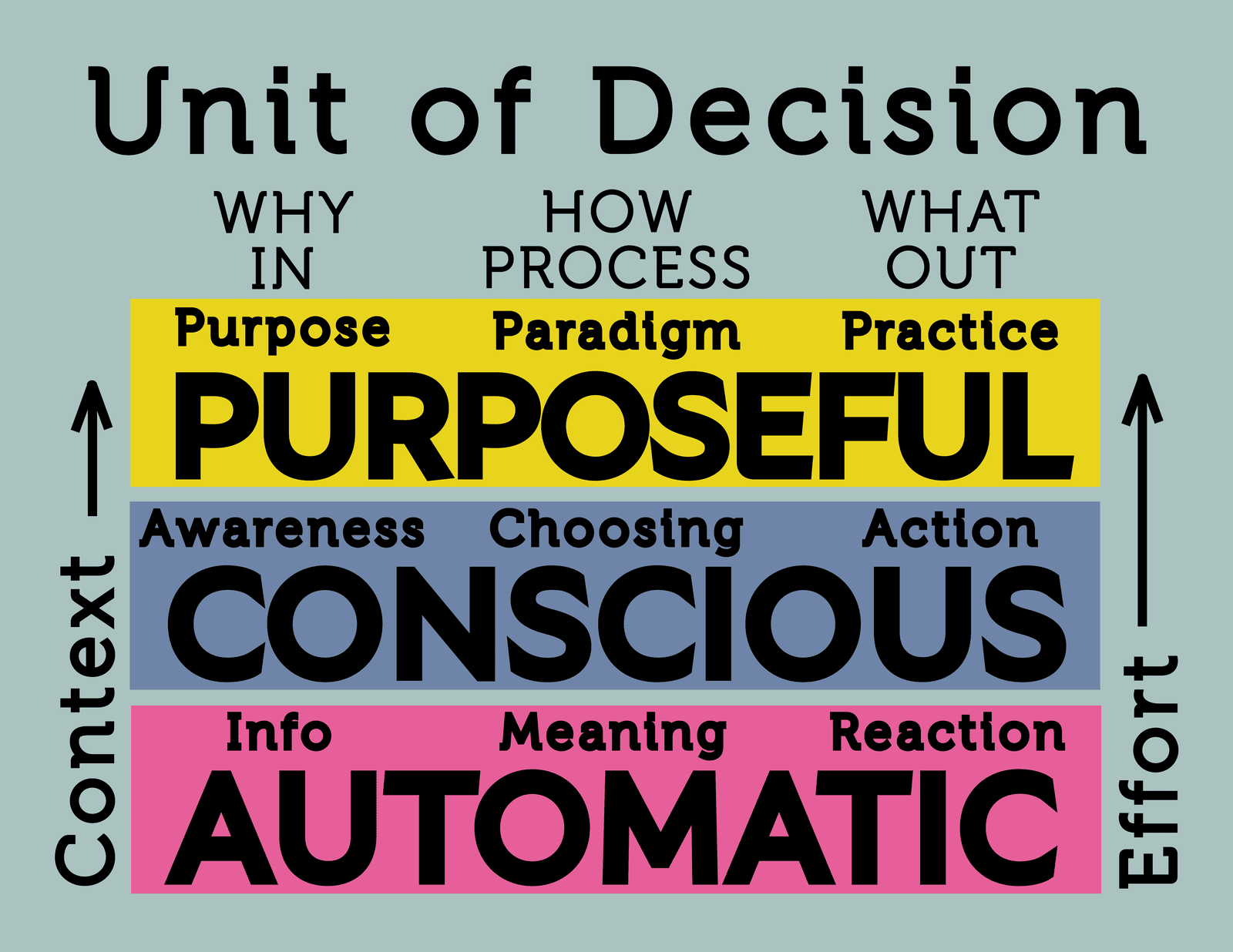
You run Care → Think → Act at three different levels — and most of the difference between a reactive life and a deliberate one is which level you're operating at, and whether you chose it.
Automatic
Fast, patterned, efficient.
Conscious
Effortful, flexible, choosing.
Purposeful
Values and best ideas, integrated with action.
The skill isn't staying conscious every second — that's impossible and exhausting. It's moving between levels appropriately: knowing when to trust your patterns, when to override them, and when to connect a single choice to something larger.
Decision is the anatomy — the parts and how they fit. Mindsets, the next spoke, is the physiology: what these three levels feel like from the inside, and how you actually move between them.
Learning to See It Over Time
The capacity to see and steer a decision develops in stages. The same structure deepens as a person grows.
| Stage | What Decision Looks Like | Decision Skill |
|---|---|---|
| Agent-HabitsAges 8–12 | "Decisions have parts" | Naming Care, Think, and Act inside a real choice — seeing the sequence instead of only the outcome |
| Artist-ToolsAges 12–16 | "I can run the sequence on purpose" | Slowing a decision down, catching the care behind a reaction, testing whether the thinking actually holds |
| Hero-IdealsAges 16–20 | "I decide in line with what I value" | Connecting decisions to chosen ideals — making the purposeful level a practice, not an accident |
| Whole-Real HumanAges 20–24+ | "I help others see their decisions" | Coaching the structure in others; designing choices and environments that make good decisions easier to make |
Decision Runs Through Everything
Decision isn't a separate topic — it's the unit the rest of the Core Code is built on.
Autopilot
Autopilot is the automatic level running unsupervised. The wake-up is simply noticing that a decision was made — and that you could have made it on purpose.
Mindsets
If Decision is the anatomy of the three levels, Mindsets is the physiology — what Automatic, Conscious, and Purposeful feel like, and how you move between them.
Story
Decisions are made inside the stories you're living in — the narrative shapes what you care about and what looks possible. You can't fully separate how you choose from the story you're inside.
Authorship
One decision is a sentence. A life of decisions made on purpose is authorship — the long arc of writing your own story, choice by choice.
Teaching This Concept
- Start with a real, small decision they made today. Walk it backward into Care, Think, Act. The structure is invisible until you name it on a concrete example — "what mattered, what you weighed, what you did."
- Pull the three stages apart out loud. Most young people collapse all three into "I just did it." Slowing one ordinary choice into three beats — care, think, act — is the whole lesson.
- Name the failure modes without shaming. Impulse, cold calculation, and autopilot are things everyone does, including you. Model catching your own in real time; that permission is what makes it safe for them to look at theirs.
- Don't demand constant consciousness. The goal isn't to make every decision effortful — that's exhausting and impossible. It's noticing when the automatic isn't serving and shifting. Over-correcting into analysis-paralysis is its own failure mode.
- Plant the thread to Mindsets. Decision is the anatomy lesson; it sets up the three-levels work that Mindsets develops. Leaving them curious about "how do I move between the levels?" is exactly the right hook.