
Mindsets
What the three levels feel like from the inside — and how you learn to move between them on purpose.
The Three Levels, From the Inside
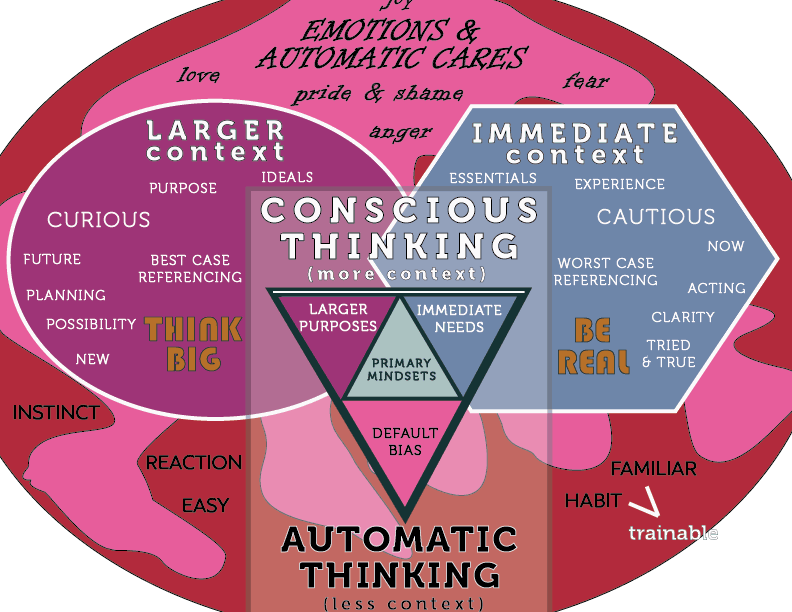
You met these three as structure on the Decision page. You live them as states. At any moment you're operating at one of them, and the first move toward steering your own life is simply learning to feel which one you're in.
Automatic
Running without you.
Conscious
You, awake and deciding.
Purposeful
Acting from who you mean to be.
None of these is the "good" one. Automatic isn't a flaw to be eliminated — you'd be paralyzed without it. Conscious isn't a virtue to live in permanently — it's too costly to sustain. Purposeful is rare by design. The point isn't to pick a level and stay there. It's to know which one you're in, and to be able to change it.
The Skill Is the Shift
If Decision named the levels, Mindsets is about the motion between them. You can't white-knuckle your way to constant consciousness; the mind doesn't work that way, and trying is exhausting. The real capacity is narrower and more useful: catching the moment when your automatic isn't serving you, stepping up to choose, and then letting the better pattern run on its own.
Consciousness isn't a place to live. It's a move you make — catching the automatic when it stops serving you, deciding on purpose, then letting the new pattern run by itself.
The motion goes both directions. Up is the wake-up: a pattern fires, you catch it, and you climb into conscious choosing. That's the move everyone notices. But down matters just as much — a response you've chosen often enough sinks back into automatic and runs without effort. That descent isn't backsliding. It's the whole goal. A skill you had to think about, that you now simply do, is a decision you've already won.
Two Stances: Think Big and Be Real
Conscious choosing isn't a single act — it's a conversation between two stances. Most decisions that go wrong at this level go wrong because one stance crowded out the other.
Think Big
Possibility, purpose, what could be.
Be Real
Truth, constraint, what's actually so.
You need both, held at once. Think Big without Be Real is daydreaming. Be Real without Think Big is quitting before you start. Holding the two in tension — reaching, and staying honest about the ground under the reach — is most of what purposeful decision-making actually feels like.
Your Automatic Is Editable
The levels aren't a ladder you're stuck on. Every skill you have now — reading, walking, the way you greet a friend — was once effortful and conscious, and became automatic through practice. That same path is open to you on purpose. A response you choose consciously, again and again, eventually runs by itself. You are not fighting your autopilot. You are rewriting it.
Learning to See It Over Time
The capacity to feel which level you're in — and to change it — develops in stages. The same skill deepens as a person grows.
| Stage | What Mindsets Looks Like | Mindset Skill |
|---|---|---|
| Agent-HabitsAges 8–12 | "There are different gears" | Noticing the difference between doing something on autopilot and doing it on purpose — that the two even feel different |
| Artist-ToolsAges 12–16 | "I can change gears" | Catching the automatic mid-run and stepping up to conscious; practicing a chosen response until it sticks |
| Hero-IdealsAges 16–20 | "I choose the gear, in line with who I am" | Reaching for the purposeful level deliberately; holding Think Big and Be Real together instead of swinging between them |
| Whole-Real HumanAges 20–24+ | "I help others find their gears" | Coaching the shift in others; building environments where the better automatic is the easy one to fall into |
Mindsets Runs Through Everything
Mindsets is the lived layer underneath the rest of the Core Code — the felt experience the other ideas are describing.
Autopilot
Autopilot is the automatic level running unsupervised. Mindsets is what it feels like to wake up from it — and the practice of not just waking, but choosing where to go next.
Decision
Decision is the anatomy: the parts of a choice and the levels it can run at. Mindsets is the physiology — those same levels as felt states, and the movement between them.
Authorship
Moving between levels on purpose, over and over, is how a life gets written. Mindsets is the muscle; authorship is the long arc that muscle builds.
Principles
Reflective Thinking — noticing your own mind in action — is the capacity every shift depends on. Mindsets is that principle made physical.
Teaching This Concept
- Name the level out loud, in the moment. When you catch a young person reacting on autopilot — or visibly pausing to think — say which level it is. The vocabulary only becomes useful once it's attached to something they just did, not to a worksheet.
- Make the shift visible, not the lecture. The lesson isn't "be more conscious." It's the felt experience of catching one automatic reaction and choosing again. One real shift they notice in themselves beats an hour of talking about shifting.
- Protect the automatic. Don't teach this as if Level Two is virtue and Level One is sin. Most of a good life runs automatically. The goal is a well-trained autopilot, not a permanently effortful one — and saying so out loud keeps them from chasing an impossible standard.
- Teach Think Big and Be Real as a pair. Young people tend to over-index on one — all reach, or all caution. Name both, and treat holding them together as the actual skill, rather than picking the one that comes naturally.
- Point to trainability when they're discouraged. The most hopeful thing here is that the automatic is editable. A response practiced on purpose becomes who they are. That's worth saying directly the moment a pattern starts to feel permanent.