
Practice
How your story gets written in the real world — through what you actually do, repeatedly, on purpose.
The Daily Practices
Six practices of authorship — not as a rigid daily checklist, but as a vocabulary for what conscious living actually looks like. They're available in any order, at any scale, in any day.
Notice
Catching yourself in the act. What's happening in your thinking, feeling, and behavior right now — before it becomes automatic? The pause that creates authorship.
Choose
Using the space you've created. Selecting from your options deliberately rather than following the loudest impulse. Agency in action.
Check
Testing your thinking against reality. Are you seeing clearly, or are you seeing what you want? Is the reasoning actually sound?
Connect
Investing in the relationships that make your story possible. Showing up, following through, repairing when you've caused damage.
Build
Doing the thing — practicing skills, completing projects, making something. Writing actual sentences in your story, not just planning them.
Review
Reading the Result: looking honestly at what happened. What worked, what didn't, what you'd do differently. Learning from effect and adjusting.
Each one puts a part of the Core Code to work: Notice, Reflective Thinking; Choose, Personal Agency; Check, Objective Reason; Connect, Mutual Respect; Build, your Gold Star Kit; Review, the whole. Notice and Review are the same reflective muscle at two timescales: Notice in the moment, Review after the fact.
One decision is Care, Think, Act, Result. Authorship is the skill of catching that loop and steering it. The six practices are how you train that skill daily.
Practice at the Edge
Not all practice is equal. There's a difference between practice that develops your abilities and practice that just fills time. It comes down to where you're working.
Comfort
Doing what you already know. Smooth and easy — and no development happening. The brain isn't building here.
Challenge
Hard enough to require effort, not so hard that you fall apart. Struggling, adjusting, improving. This is where growth lives.
Overwhelm
Too hard, too fast. The brain shuts down. You're surviving, not learning. Back off until you're challenged, not drowning.
Deliberate practice means staying at that edge — working with focus and feedback, not just logging repetitions. The struggle is the building. Two Growth Markers name it: Deliberate Practice and Good Struggle.
Every rough draft is a step toward a better story. The question isn't whether you'll make mistakes — you will, constantly, for the rest of your life. The question is whether you'll revise. Authors revise. Characters just live with whatever happened. Failure that produces learning isn't failure. It's the mechanism of growth.
Make the Automatic Good
The aim is not to eliminate automatic thinking. It is to make the automatic good. Good habits free your mind.
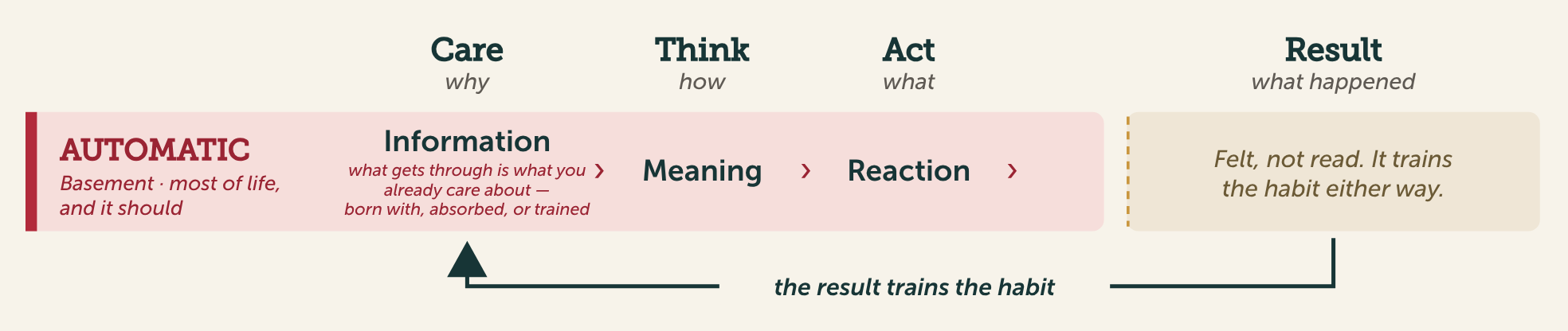
A chosen response, repeated, becomes the new automatic. That closes the loop the Autopilot page opened: most of life runs there, and practice is how you choose what runs.
The Habit Loop
Habits are how your brain automates frequently-used behavior — freeing up attention for things that require it. Understanding the loop gives you power to build the habits you want and change the ones you don't.
To build a new habit: make the cue specific, the routine small enough to actually start, and don't skip the reward. To change an existing one: keep the cue and reward, substitute the routine. Start tiny — the habit that launches is worth more than the perfect habit you never start.
The reward is a feeling. Telling you how it went is one of the three jobs feelings do, and it is what teaches the loop to run again.
The Body Is the Platform
Your brain doesn't float in space. It runs on your physical body. Every ability in the Core Code — attention, decision-making, emotional regulation, creativity — depends on the physical infrastructure underneath it.
Sleep
When you don't sleep enough, your brain works worse — period. Focus, learning, emotional regulation, decision quality: all degrade. Sleep is when the brain consolidates, repairs, and prepares. It's not optional recovery. It's the work.
Movement
Physical activity changes brain chemistry, improves mood, enhances focus, and supports neuroplasticity. Movement isn't a break from cognitive work — it's support for it. The sedentary brain is a suboptimal brain.
Environment
People with "good habits" don't have more willpower — they've designed environments where good behavior is easy. Working with human psychology produces better results than constantly fighting it.
Questions to Practice With
- Where in my life am I practicing on autopilot versus at the edge of my ability?
- What habits am I carrying that I never actually chose? Which do I want to keep?
- How do I typically respond to failure — do I revise, or do I just live with what happened?
- Am I treating sleep and movement as basics I maintain, or as luxuries I'll get to eventually?
- What's the "next action" — the very next physical step — on the thing I keep putting off?
Connected to
Autopilot
Practice closes the loop Autopilot opens. Most of life runs on automatic; practice is how the automatic gets chosen.
Authorship
Practice is how authorship becomes real — the bridge from intention to the actual words on the page.
Gold Star Kit
The practice dimension of your kit is where these ideas live as built skills and habits.
Teams
Many practices are fundamentally social — they happen in teams, through shared norms and accountabilities.
Meaning
Practices without purpose drift. Meaning is what tells you which practices are worth building.