
The Four Core Principles
First principles, not final answers. steamHouse did not pick its four principles from a list of good ones. It started with one commitment, that a person can be the conscious, purposeful author of their own life, and asked what that requires.
At the core of steamHouse are four principles every person, anywhere, needs to develop. Each names a posture, not an answer: one is what being conscious takes, and three are what it asks for in each realm of a person’s care.
Rules tell you what to do in specific situations. They work well when situations are familiar and predictable. But you can't write rules for every situation you'll encounter — life is too variable for that.
Principles are different. They're the underlying commitments that generate good judgment across situations you've never faced before. Develop the principles, and you can navigate what the rules didn't anticipate.
The four, drawn on the Care Space
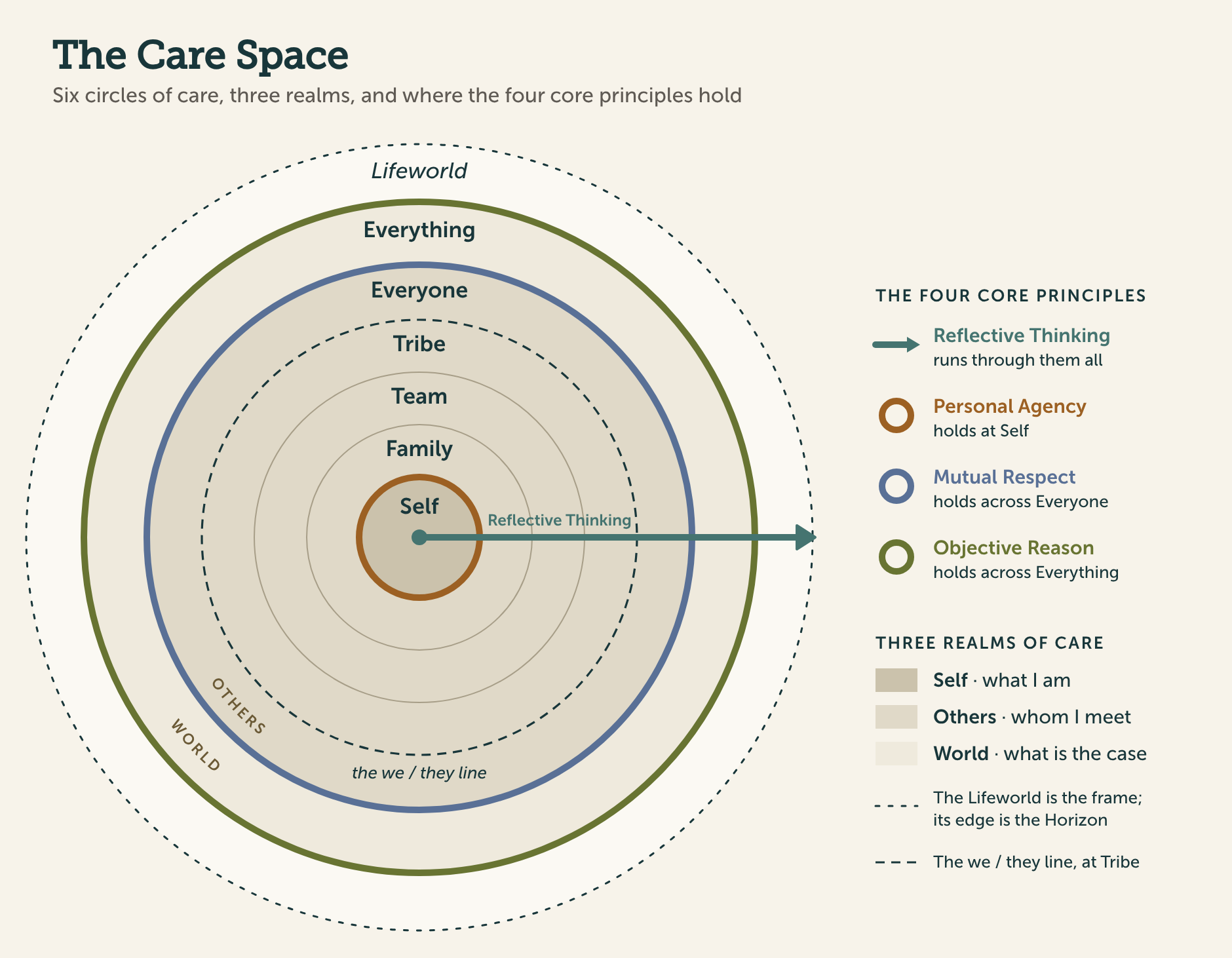
What a person cares about falls into three realms: themselves, other people, and the world, however large you take it to be. The shaded bands are the realms; the rings are the circles of care, from Self out to Everything. A colored ring marks the circle a principle holds across. The line is Reflective Thinking: it runs through every circle and ranges over the whole frame.
What it is, what it looks like, what it asks
The ability to notice your own mind while it is running: your thoughts, assumptions, emotions, and actions.
It watches over the other three core principles.
The authorship of your own life: your choices shape your world and the people in it, and your response is your responsibility.
Not that you control everything — you don't. But within constraints, you choose. Your responses are yours. Your next action is yours.
The recognition that other people are conscious authors of their own lives, not characters in yours.
It requires acknowledgment, not agreement.
The commitment to letting evidence shape belief rather than the other way around: wanting to know what is true more than wanting to be right.
Your feelings are real. Your perceptions are real. But reality doesn't rearrange itself to match them.
An argument from one value, set out so it can be examined
We did not pick these from a menu. We argue them from one value: that a person should become the conscious, purposeful author of their own life. Start with “conscious.” You can’t author what you can’t see, so the first requirement is the ability to notice your own mind while it is running. That is Reflective Thinking.
Then we sorted what a person cares about into three realms, within one frame, and asked the same question of each: what principle only matters once you are awake to your own life, and cannot be derived from anything more basic? We set aside two kinds of things: what people already do without trying, and what is good but depends on something deeper. In each realm, one principle was left standing.
| Realm | Set aside | Left standing, and why |
|---|---|---|
| Self (I) | Self-interest runs automatically; self-knowledge and self-discipline serve something prior. | Personal Agency. If you don’t believe you can choose, becoming conscious has no point. Agency is what makes the rest matter. |
| Others (you) | Justice is a conclusion, not a starting point; reciprocity centers what you get back; care alone can slide into condescension. | Mutual Respect. Other people are authors too. It is the same value, seen from outside. And no one develops alone. |
| World (it) | Curiosity drives inquiry but doesn’t check it; humility says how to hold a conclusion, not how to reach one. | Objective Reason. Reality does not bend to what you want, and your thinking should track it. |
That leaves “purposeful.” Being conscious is noticing in the moment. Being purposeful is the same noticing turned on the whole of your life, the frame the three realms sit within. What you find there, and what you decide it is for, is yours.
This is an argument, not a proof. It can be contested, and we want it examined. What it claims is narrower and sturdier than consensus: these are the principles a person set on authoring their own life can least afford to do without.
The order the four are argued in. It is not a ranking
The whole of a life is too large, and too taken for granted, to steer without examining it. This is why Reflective Thinking comes first and runs through everything.
They are what being conscious requires in each realm, not a ranking of what matters most there.
What you love most, and what you hold sacred, are yours to author.
What steamHouse argues for, and where it stops
steamHouse holds one value as its own: that a person should become the conscious, purposeful author of their own life. We hold it openly and argue for it; it is not proven. Everything else in the framework builds the abilities that value requires. It gives no answers: where a person lands is theirs to author. The four core principles are not more values stacked on top; they are argued from that one. Every other value (what a person believes, holds sacred, or decides their life is for) stays entirely theirs. We make the case for these principles; you author the rest.
Most frameworks either claim neutrality while carrying values they never name, or assert values on authority. steamHouse names what it stands on, argues for it, and stops.
| What we reason toward, and argue for | What you author |
|---|---|
| The one value: becoming the conscious, purposeful author of your own life, with a purpose of your own, consciously chosen | What your ideals contain: which commitments, which picture of a good life |
| The four core principles | Your conclusions on the contested questions: God, the afterlife, politics, ultimate meaning |
| The direction from automatic, to conscious, to purposeful living | How the principles take shape in your own relationships, field, and work |
That stopping point is what keeps a formation community from becoming an ideological one.
If you hear the first line, here is what we mean
“They are steamHouse’s values.”
steamHouse holds one value. The principles are argued from it, in the open.
“They rank what matters most.”
They are what being conscious requires in each realm, not a ranking of what matters most there. What you love most, and what you hold sacred, are yours to author.
“They are capacities.”
Caring, thinking, and acting are the capacities everyone is born with. The principles are postures a person develops in how those capacities get used.
“Respect means agreement.”
It requires acknowledgment, not agreement. People who disagree deeply can hold it together.
“Reason means running life like a lab.”
Most choices are made fast, with partial information. The commitment is to let evidence shape belief, not to turn every decision into an experiment.
“Reflection means overthinking.”
Most of life runs automatic, and should. Reflection is going conscious at the moments that matter.
"Four facets of the same diamond — each implies the others, each requires the others."
What it looks like in a real moment
The Decision to Speak Up
A friend's plan seems likely to fail. Do you say something?
Self-governance also depends on people who live by the four core principles: Reflective Thinking keeps you from total capture by your tribe; Personal Agency makes citizens rather than subjects; Mutual Respect lets people who disagree cooperate; Objective Reason keeps a public sphere from collapsing into competing fictions. When fewer people live by them, democratic life thins.